
IPPCAAS Uncovers Rapid Evolution Mechanism of Mitochondrial DNA in Predatory Mites
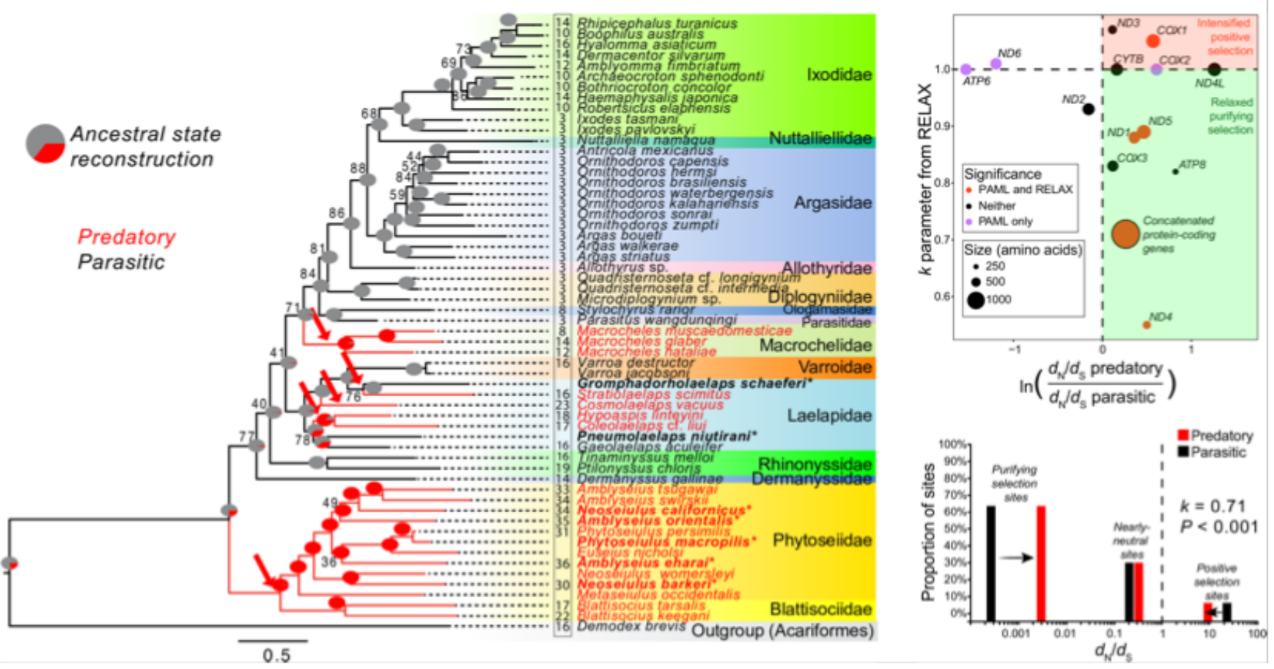
Recently, Predatory Mite Research Group at the Biocontrol Innovation Center, IPPCAAS, collaborated with The University of Texas at Austin to publish a paper entitled “Positive and relaxed selection on mitochondrial DNA in parasitic versus predatory mites” in the Q1 journal Philosophical Transactions of the Royal Society B-Biological Sciences. By comparing the evolutionary characteristics of mitochondrial genome between predatory and parasitic mites, the study reveals that the rapid evolution of mitochondrial DNA in predatory mites is driven by relaxed purifying selection rather than by adaptive positive selection as previously hypothesized.
Owing to its distinctive inheritance patterns, haploid state and high mutation rates, mitochondrial DNA tends to accumulate slightly deleterious mutations, thereby following evolutionary trajectories distinct from those of nuclear DNA. Previous studies have often interpreted mitochondrial DNA variations as being associated with environmental adaptation, and have assumed that high-energy-consumption lifestyles are accompanied by positive selection on mtDNA. Nevertheless, both positive selection and relaxed selection can lead to elevated dN/dS ratios (non-synonymous/synonymous substitution rates). Positive selection drives the fixation of beneficial non-synonymous mutations, while relaxed selection weakens the removal of deleterious mutations. Given their fundamentally distinct evolutionary drivers, distinguishing between these two modes of selection is of considerable importance.
Focusing on mites within Parasitiformes, this study explored the selection pressures shaping mitochondrial genome evolution during the transition from parasitic to free-living predatory lifestyles. Two mutually exclusive hypotheses were proposed and verified: 1) relaxed selection accelerates mtDNA evolution in parasitic mites; 2) positive selection associated with locomotive performance promotes mitochondrial gene evolution in predatory mites. The research also analyzed the correlation between various feeding habits of phytoseiid mites (polyphagous, monophagous, pollen-feeding, etc.) and mtDNA evolution.
Results support multiple independent origins of predatory mites. A substantial number of breakpoints were identified in the mitochondrial gene order of Phytoseiidae mites, indicating extensive and ongoing mitochondrial gene rearrangement. Among 13 mitochondrial protein-coding genes, predatory mites exhibited markedly higher dN/dS ratios than parasitic mites. RELAX analysis showed that dN/dS ratios tended to converge on 1 in predatory versus parasitic
mites, reflecting relaxed selection (k = 0.71, p < 0.001). This evidence confirms that mitochondrial gene evolution is governed by relaxed purifying selection instead of intensified positive selection, validating the relaxed selection hypothesis. Contrary to the conventional expectation, the rapid evolution of mitochondrial DNA in high-energy-consuming predatory mites is driven by relaxed purifying selection rather than adaptive positive selection.
Zhang Bo and Xu Xuenong from the IPPCAAS serve as co-corresponding authors. Dr. Justin Havird from The University of Texas at Austin is the first author. The study was funded by the National Key Research and Development Program of China and grants from the National Institutes of Health of the United States.
Link: https://royalsocietypublishing.org/rstb/article/381/1947/20250083/481188/Positive-and-relaxed-selection-on-mitochondrial?searchresult=1
-
 Assistant Director-General of the UN Food and Agriculture Organization Leads Delegation to Visit IPPCAAS
 -
 International Symposium on Plant Biosafety (ISPB 2025) Convenes in Guangzhou — Science-led plant health governance to secure food systems and advance the SDGs
 -
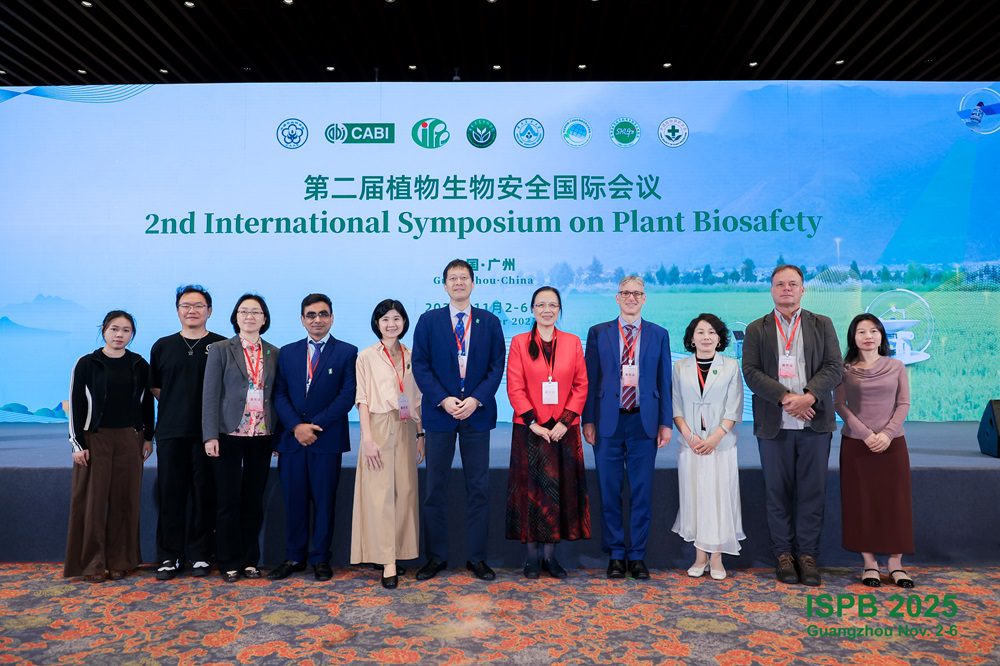 Three decades of China's membership of CABI celebrated at 2nd International Symposium on Plant Biosafety
 -
 CABI receives recognition from FAO for its work to support sustainable plant production and protection