

IPPCAAS Reveals Novel Immune Mechanism of 14-3-3 Proteins in Regulating Rice Disease Resistance
Recently, the Crop Pathogen Functional Genomics Innovation Team at the IPPCAAS, published a research paper online in Nature Communications titled “A phosphorylation-dependent ubiquitination switch orchestrates nuclear immune reprogramming upon chitin perception”. This study reveals a 14-3-3 protein-mediated immune signaling cascade that depends on phosphorylation and ubiquitination modifications. It elucidates the molecular mechanism by which rice transmits pathogen recognition signals from the cell membrane to the nucleus to defend against infection by Magnaporthe oryzae.
Rice is one of the most important food crops globally. Rice blast, caused by the fungus Magnaporthe oryzae, is the most devastating fungal disease, often leading to significant yield losses. Plants initiate defense responses through their innate immune system by recognizing pathogen-associated molecular patterns. However, the precise transmission of perception signals from the cell membrane to the nucleus, where they regulate the expression of defense-related genes, has been a central scientific question in plant immunology. The 14-3-3 proteins are highly conserved regulatory proteins in eukaryotes and play important roles in plant immunity, yet the mechanisms governing their homeostasis have remained unclear.
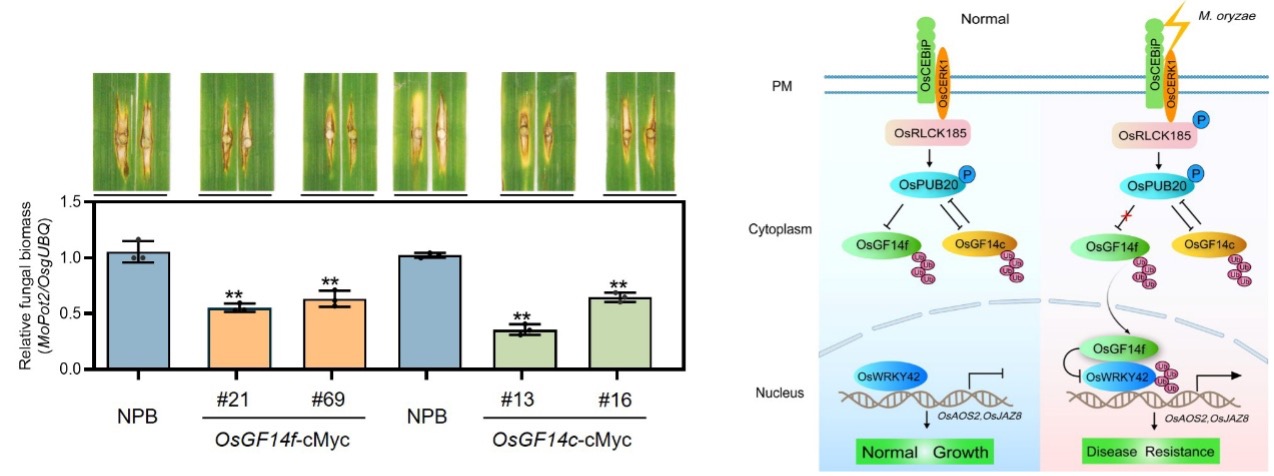
This study found that two homologous 14-3-3 proteins in rice, OsGF14f and OsGF14c, act as positive regulators of resistance against rice blast. Further investigation revealed that these two proteins are degraded by the 26S proteasome system. Using an optimized screening and identification system, along with a rice E3 ubiquitin ligase library (UbE3 library) developed by the team, the E3 ubiquitin ligase OsPUB20, which targets both OsGF14f and OsGF14c, was identified. OsPUB20 ubiquitinates OsGF14f and OsGF14c, promoting their degradation via the 26S proteasome pathway, thereby negatively regulating rice resistance to M. oryzae. However, upon rice perception of chitin signals, the receptor-like cytoplasmic kinase OsRLCK185 specifically phosphorylates OsPUB20 at threonine 153 (Thr153). This phosphorylation weakens the interaction between OsPUB20 and OsGF14f, subsequently inhibiting the ubiquitination and degradation of OsGF14f by OsPUB20. This leads to the accumulation of OsGF14f protein and enhances rice disease resistance. The study further found that during M. oryzae infection, the OsGF14f protein rapidly translocates to the nucleus, where it facilitates the degradation of the transcription factor OsWRKY42 via the 26S proteasome pathway. The degradation of OsWRKY42 relieves its transcriptional repression of the jasmonic acid signaling pathway genes OsAOS2 and OsJAZ8, thereby enhancing rice resistance against rice blast. In summary, this study establishes a novel immune cascade signaling module: “receptor-like cytoplasmic kinase OsRLCK185 - E3 ubiquitin ligase OsPUB20 - 14-3-3 protein - transcription factor OsWRKY42.” It is the first to identify an E3 ubiquitin ligase targeting 14-3-3 proteins during plant immunity and provides an in-depth analysis of the homeostatic regulation and nucleocytoplasmic shuttling mechanisms of 14-3-3 proteins. This research not only offers a new perspective for understanding the transmission of plant immune signals from the cell membrane to the nucleus but also provides new targets and a theoretical basis for molecular breeding of disease-resistant rice.
Dr. Chongyang Zhang, a jointly trained postdoctoral fellow who has now completed her tenure at the IPP and the Agricultural Genomics Institute at Shenzhen, CAAS (currently an Associate Professor at the School of Advanced Agricultural Sciences, University of Science and Technology Beijing), is the first author of the paper. Professor Yuese Ning is the corresponding author. The research was supported by grants from the National Natural Science Foundation of China, the National Key Research and Development Program of China, and the Basic Science Research Center Project of the Agricultural Science and Technology Innovation Program of the CAAS.
-
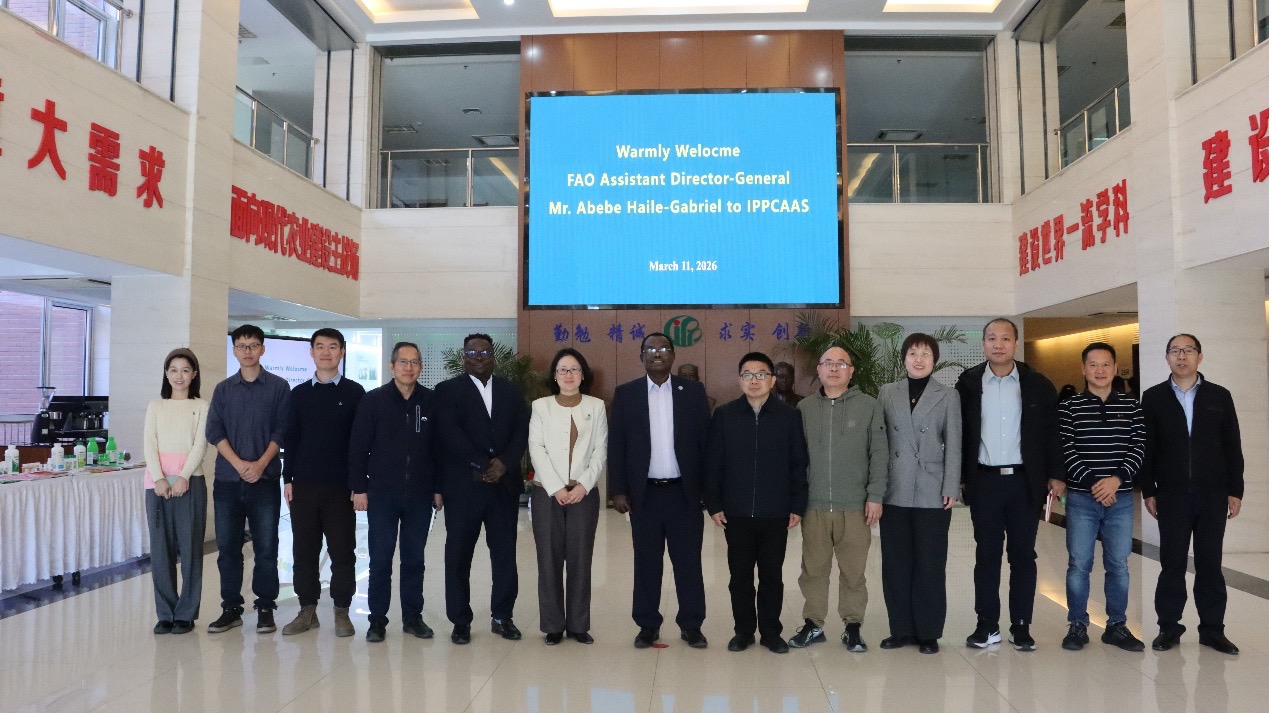 Assistant Director-General of the UN Food and Agriculture Organization Leads Delegation to Visit IPPCAAS
 -
 International Symposium on Plant Biosafety (ISPB 2025) Convenes in Guangzhou — Science-led plant health governance to secure food systems and advance the SDGs
 -
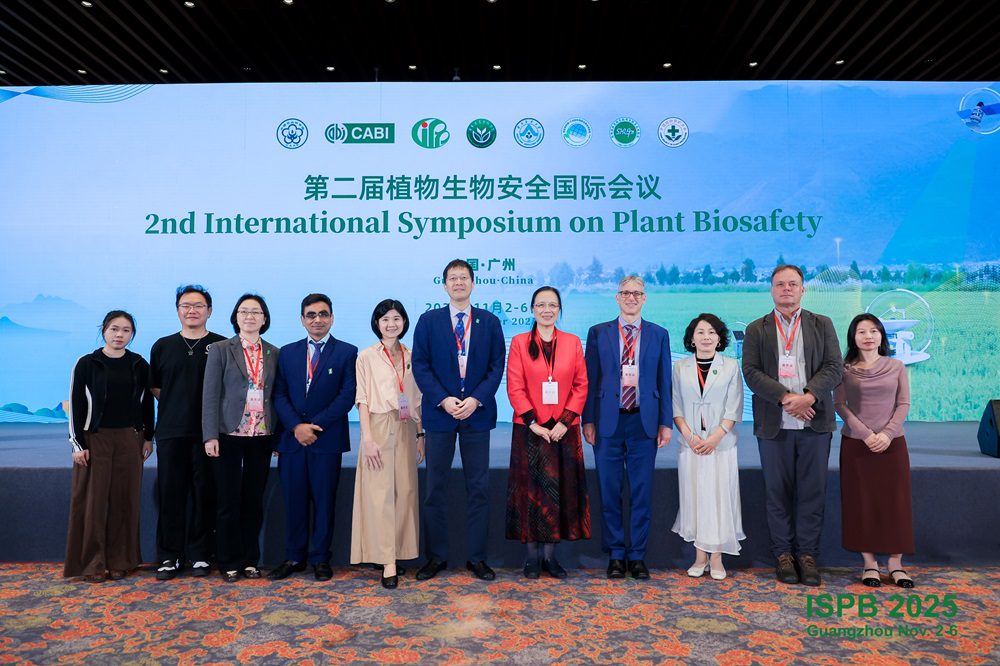 Three decades of China's membership of CABI celebrated at 2nd International Symposium on Plant Biosafety
 -
 CABI receives recognition from FAO for its work to support sustainable plant production and protection